



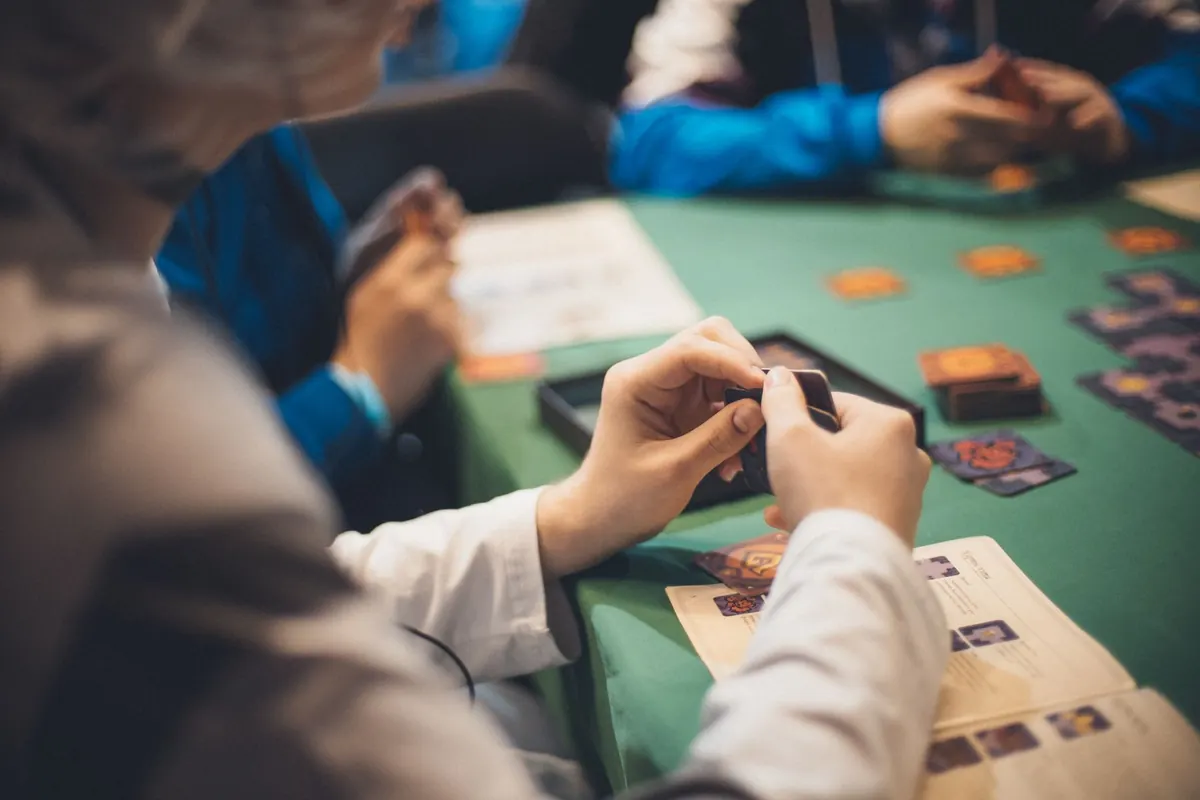
Walk into a big bridge congress for the first time and the room tells you a good deal. Rows of tables under hotel lighting, a low murmur, a director testing the microphone, and several hundred people who all seem to know exactly where to put their coffee. It can feel like arriving late to a club you never knew existed. It isn't. The British Bridge Congress is one of the biggest fixtures on the British bridge calendar, and a fair number of the people in that room are there for the first time too.
Here is what to expect, how to enter, and how to get something out of a first visit without pretending to be an expert.
What the Congress actually is
The Congress is run by the English Bridge Union, usually staged over several days in a large hotel or conference venue, with play in one or two big halls. The boards are duplicated, so everyone in your event plays exactly the same deals. Results are scored against the whole field, master points are awarded, and qualified directors are on hand whenever something goes wrong.
That sounds formal. In practice a congress is a club night scaled up: the standard is higher, the sessions are longer, the rulings matter more, but the mood is friendly. The pair at the next table will happily point you towards the tea.
Choosing what to play
Congresses offer a menu rather than a single competition: pairs and teams, single sessions and two-session events, Swiss formats where you play a run of short matches against different opponents, and sometimes qualifiers leading to a final. Most first-timers pick one or two events and leave plenty of gaps.
The distinction worth understanding is scoring. Pairs is matchpointed, so every trick counts and an overtrick can be worth as much as a slam. Teams is scored by IMPs, where making or defeating a contract matters far more than one extra trick. If you have only ever played pairs, a teams event will feel like a different game.
If you are new to congresses
Look for events labelled restricted, intermediate or novice. Most congresses run at least one, usually at a lower system level and with a gentler field. It is the best possible use of a first day: you will be among players in the same position, and you will get used to the venue, the scoring and the pace before taking on the main field.
If you are ready for the main events
Enter the main pairs by all means. You will meet some very good players and will probably finish in the lower half of the field; that is normal and it is not the point. You will also meet plenty of ordinary club pairs, and you will learn more in two sessions than in a month of club nights. If you can raise a team of four, the teams events tend to be the friendliest part of any congress.
Entering: the practical bits
Almost all entries are made in advance, online or by post, and the popular events fill. Worth sorting early:
- Check the deadline. Late entries are sometimes accepted and sometimes not, and the event you wanted may already be full.
- Confirm your partner. Both of you need to be entered, and organisers will usually want a way to identify each player, such as an EBU number.
- Ask about partnership help. If you cannot find a partner, say so when you enter. Many congresses keep a list and will match people up.
- Book accommodation early if the event is residential. The host hotel is convenient, and it goes first.
- Check what is included. Some congresses provide meals or a social dinner; many do not. Entry fees are charged per person per event and they add up over a long weekend.
Table etiquette that actually matters
Nobody expects perfect manners from a newcomer, but a few habits mark you out as someone who belongs.
- Use the bidding box properly. Do not touch it before it is your turn, and do not hover over a bid you have no intention of making.
- Alert and announce as the regulations require. If you are unsure, ask a director before the session rather than at the table.
- Say nothing about the hand while it is being played. Not a sigh, not "sorry partner", not "that was lucky". Save it for after the round.
- Call the director when something goes wrong. It is not an accusation; it is how the game keeps its results fair.
- Put your phone away — off, and in a bag, not face down on the table.
- Keep a steady tempo, and do your thinking before you play to trick one.
- Do not criticise partner. Everyone notices, and it costs you more than a bad board.
Post-mortems are welcome. Have them in the bar, not at the table.
Systems, alerting and convention cards
Each event is played at a stated system level, printed in the programme. If you play a straightforward Acol or Standard English system with a handful of common conventions, you will almost certainly be within the rules for the main events and comfortably within them for a novice event. Check the level if you play anything unusual.
Fill in a convention card, bring two copies, and put it on the table. It takes ten minutes at home and saves a great deal of awkwardness later.
Staying sharp, and enjoying it
Congress sessions run long, often twice a day, and tiredness costs more tricks than bad bidding. Eat properly, drink water, walk about between sessions, and resist replaying every hand in the break. Big halls are either stuffy or freezing, so dress in layers. If you are playing in a team and you are running on empty, tell your teammates rather than quietly costing them IMPs.
The people who enjoy a first congress most treat it as an experiment: a couple of events, a look at how the strong pairs carry themselves, a drink with opponents they have just met.
A short checklist for the week before
- Confirm your entry, your partner and your start times.
- Agree your system and fill in two convention cards.
- Check the system level for your event.
- Book travel, parking and accommodation, and find out which room you are playing in.
- Pack a pen, water, a spare layer and your card.
- Arrive early on the day, find your table, and say hello to the opponents.
That is the whole secret. The Congress is large, but it is made up of tables of four, and you already know how to play at one of those.
Photo: Olga Fedina / Pexels
Related posts
More stories you’ll love reading