



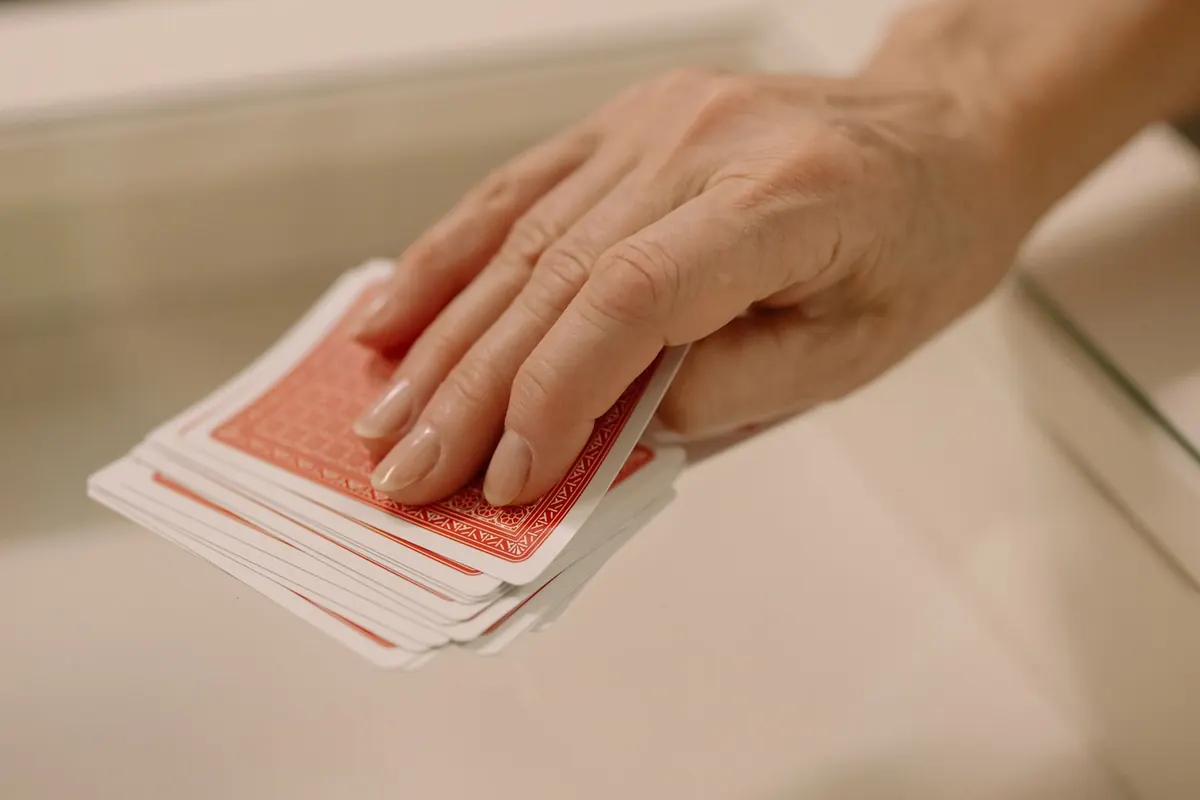

Bridge has a reputation for being hard to learn. It isn't, provided you start with a book that teaches one thing at a time and gives you hands to practise with. The difficulty is choosing. Bookshop shelves are crowded with titles that assume you already know what a transfer bid is, and best-of lists tend to recommend classics written for players who already have a hundred deals behind them. The five below genuinely start at the beginning. Each entry says what the book does well, where it falls short, and which reader it suits. All five are still easy to find in 2025, whether new, reprinted or second-hand.
What Makes a Good First Bridge Book
Before the recommendations, here is the test I applied. A book can fail one or two of these and still be worth owning later, but a first book needs to pass most of them.
- Defines the vocabulary before using it. "Dummy", "ruff", "finesse" and "trump" should be explained, not assumed. A good beginner book introduces a term, uses it twice in the next paragraph, and only then relies on it.
- Teaches one bidding system and stays with it, rather than offering three alternatives on every page. You cannot learn a system and its alternatives at the same time.
- Introduces the play of the hand early. Bidding is easier to absorb once you understand why you want to be in 3NT rather than 4♠.
- Includes quizzes or set deals, so you can test yourself rather than nod along. Reading a bridge book feels like learning; answering the questions is learning.
- Is short enough that you will reach the last page. A 180-page book you finish beats a 500-page reference you abandon at chapter four.
1. Bridge Basics 1: An Introduction by Audrey Grant
Audrey Grant's Bridge Basics series is widely used as a teaching text in North American clubs, and the first volume is a model of patience. It opens with the minimum you need to bid a hand, then adds responding, then declarer play, then defence. Each idea gets its own short chapter and a set of exercises, and the chapters are short enough to finish in a single sitting.
What makes it work is the pacing. Grant does not introduce Stayman until the simple auction of 1♠–2♠–4♠ makes sense to you, and she does not mention slam bidding at all in the first volume. The result is a book that never makes you feel behind.
Pros: nothing is rushed, the diagrams are clean, and the series carries on into later volumes if you want a structured path. Cons: it teaches American methods, so a UK club player will need to adjust when they move to Acol. Who it suits: the complete beginner who would rather work through a course than dip in and out.
2. Beginning Bridge by Barbara Seagram and Linda Lee
Seagram is one of bridge's best-known teachers, and this book shows it. It is written for classroom use, with review quizzes at the end of each section and plenty of worked examples. The tone is conversational and encouraging without being fluffy: you are told to count your losers, not told that bridge is a wonderful journey.
The quizzes are the selling point. Each chapter ends with roughly a dozen questions in the same format as the examples you have just read, so you can find the gap in your understanding before it hardens into a habit. Seagram and Lee also deal with the small practicalities that other authors skip, such as how to fill in a scoreslip and what to say when you want to look at the opponent's convention card.
Pros: excellent exercises, warm tone, and a natural companion to a real-life beginner course. Cons: like Grant, it is written for the American Standard system, and the play sections assume you will have a teacher nearby. Who it suits: anyone taking a club class, or the self-taught reader who wants to be quizzed rather than lectured.
3. Bridge for Dummies by Eddie Kantar
Kantar writes the way a good club player talks: blunt, funny, and allergic to jargon. His entry in the For Dummies series is the thickest book on this list, and it is best treated as a reference rather than a course. Read the first five chapters straight through, then keep it beside you at the table and look things up as they come.
Its particular strength is hand evaluation. The chapters on counting winners at no-trump and on opening leads are clearer than in many books twice their length, and Kantar is unusually good at explaining why a bid is wrong rather than simply declaring it so.
Pros: enormous coverage, genuinely funny, and useful for years rather than weeks. Cons: the breadth is also the weakness, since no single topic gets the depth a raw beginner needs; it also jumps between American Standard and 2-over-1 in places. Who it suits: the reader who wants one book that will last, and who is willing to skip ahead and come back.
4. Bridge for Complete Beginners by Paul Mendelson
If the club you plan to join is in Britain, Ireland or much of the Commonwealth, you will be playing Acol, and the American titles above will steer you wrong on the very first bid. Mendelson's book is the cleanest introduction to Acol currently in print. It teaches the weak no-trump, four-card majors and simple limit bidding, and it explains the scoring early, which makes the whole game suddenly logical.
Pros: correct for Acol clubs, brisk but never rushed, and short enough to read in a fortnight. Cons: the section on declarer play is thinner than Seagram's, so you may want a second book on card play later. Who it suits: any beginner who knows they will be playing Acol, and who wants to be able to sit down at a club night without unlearning anything.
5. The Fun Way to Serious Bridge by Harry Lampert
Lampert's book is older, illustrated with cartoons, and built almost entirely from puzzles. Each page poses a small problem, gives you a moment to think, then explains the answer. It covers bidding and play side by side rather than in separate halves, which mirrors how the game actually feels at the table.
It is also the most forgiving book here. You cannot fail it, because every question is answered on the following page, and the illustrations keep the mood light when the logic gets dense.
Pros: genuinely enjoyable, cheap second-hand, and ideal for a younger reader or anyone who has bounced off a textbook. Cons: the system it teaches is the Standard American of its era, with no transfers, and the print in some editions is small. Who it suits: the reader who needs to be entertained while learning, and who learns best by solving rather than by reading.
How to Get the Most Out of Your First Bridge Book
Whichever you choose, the method matters as much as the title.
- Deal the hands out. When a book shows a diagram of thirteen cards, take a real deck and build it. Physically sorting a hand teaches you shape faster than any paragraph.
- Cover the answer. Every example should be an attempt, not a demonstration. Guess the bid or the play before you read on, even if the guess is wrong.
- Do the quizzes twice. Once when you reach them, and again a week later. The second pass is the one that tells you what you actually know.
- Play between chapters. Twenty minutes online or at a kitchen table with a friend will do more for your bidding than twenty pages.
- Reread the play chapters. Bidding is memorisation; play is a skill. The second reading of a play chapter is where the real improvement happens.
You will not learn bridge by reading. You will learn it by reading a little, dealing a hand, getting it wrong, and finding out why.
Where to Go After Your First Book
Once you have finished one of the five, resist the urge to buy six more. Move to the second volume of the series you started — Grant's Bridge Basics 2, or Seagram and Lee's follow-up on defence — and read a single book on declarer play alongside it. Kantar's short Introduction to Declarer Play and Introduction to Defender Play pair well with anything here. Save the classics, including S.J. Simon's Why You Lose at Bridge, for your second year. They are wonderful books, and they will mean far more to you once you have lost a few games of your own.
Photo: svecaleksandr249 / Pixabay
Related posts
More stories you’ll love reading